Landscaping Pricing Guide: How to Price Your Work Profitably
A practical guide to landscaping pricing — covering hourly rates, per-square-foot benchmarks, overhead recovery, and the markup math that determines whether you're making money.
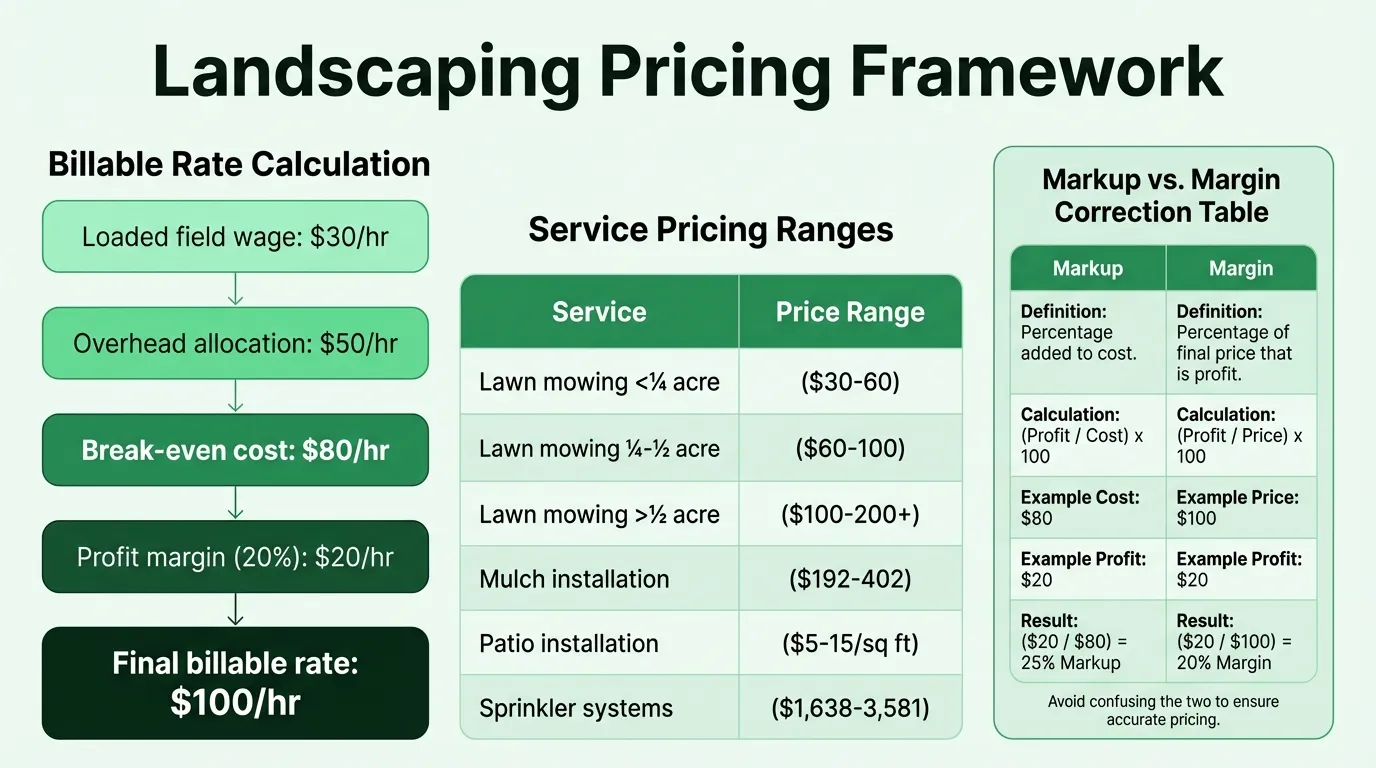
Most landscaping businesses stay busy. The ones that stay profitable know their numbers.
The gap between the two is usually pricing. A landscaper who sets rates by feel — rounding to a number that feels competitive — is likely leaving money on a good week and losing money on a bad one. The fix isn't charging more across the board. It's building prices from the actual cost of the work.
The Four Pricing Models in Landscaping
Different services call for different approaches. Using the wrong model for the job type creates pricing that's either overpriced (losing bids) or underpriced (working for free).
Hourly rate works for unpredictable or time-intensive jobs — tree removal, installation work where scope is unclear, irrigation troubleshooting. Standard range: $50–$100 per crew member per hour. The downside is that it penalizes efficient crews and can make total costs feel open-ended to the customer.
Flat rate per visit is the right model for recurring maintenance — mowing, fertilization, seasonal cleanup. It's predictable for customers and rewards speed on your end. Price based on typical job duration, not by timing the crew.
Per square foot pricing fits installation work where area is the primary cost driver: sod, turf, mulch, hardscaping. Common ranges: $4–$12 per square foot for basic landscaping, $5–$15 per square foot for patio installation, $0.90–$1.70 per square foot for sprinkler systems.
Seasonal contracts bundle recurring services into an annual or seasonal package. Residential contracts typically run $1,200–$2,500 per season for bi-weekly maintenance. Commercial contracts range from $2,000 for a small office property to $50,000+ for large campuses. Contracts improve cash flow predictability and lock in customer retention — both significant business advantages.
Most growing landscaping companies use a hybrid: flat-rate for recurring maintenance, hourly or project pricing for one-time work.
Service-by-Service Price Benchmarks
| Service | Typical Price Range | Notes |
|---|---|---|
| Lawn mowing (< ¼ acre) | $30–$60 per visit | |
| Lawn mowing (¼–½ acre) | $60–$100 per visit | |
| Lawn mowing (> ½ acre) | $100–$200+ per visit | |
| Lawn fertilization | $65–$100 per application | Annual programs: $200–$700 |
| Aeration | $107–$202 per visit | National average ~$154 |
| Mulch installation | $192–$402 per job | Varies by area covered |
| Spring/fall cleanup | $300–$600 per visit | One-time seasonal job |
| Tree trimming | $270–$1,800 per tree | Size and access dependent |
| Sod installation (1,000 sq ft) | $2,000–$3,500 | |
| Patio installation | $5–$15 per sq ft | Material-dependent |
| Hardscaping projects | $2,000–$45,000 | Scope-dependent |
| Sprinkler system (¼ acre) | $1,638–$3,581 | Average ~$2,540 |
| Landscape design | $70–$150 per hour | Full projects: $5,000–$25,000+ |
These are what customers pay — not your cost. Your cost structure sits underneath these numbers and determines whether you're making money at any given price point.
Building Your Billable Rate
The most common pricing mistake in landscaping is setting rates based on what competitors charge without knowing whether those rates are actually profitable. The right approach starts with your costs.
Labor Burden
A landscaper earning $20/hour costs significantly more than $20/hour to employ. Add employer payroll taxes (7.65%), workers' compensation insurance, and any benefits, and the true loaded cost rises to $28–$36/hour or more — before a dollar of overhead is covered.
Workers' compensation varies significantly by state and classification. Lawn and garden service work typically falls in the $3–$8 per $100 of payroll range, though this varies widely. On a $20/hour wage, that's $0.60–$1.60 per hour added to your labor cost before anything else.
Know your loaded labor rate. This is the number your estimates should be built on, not the wage you're paying.
Overhead
Every hour your crew works needs to carry a share of the costs that don't appear on the job ticket: trucks, fuel, equipment maintenance, general liability insurance, commercial auto, software, marketing, and administrative time.
A landscaping operation running two crews can easily carry $150,000–$250,000 in annual overhead. The calculation:
- Add up all annual non-job costs (everything except direct labor and materials)
- Divide by realistic annual billable hours (actual hours billed, not theoretical capacity — account for drive time, estimate time, weather days, and downtime)
- The result is your overhead rate per billable hour
Example: $180,000 annual overhead ÷ 3,600 billable hours = $50/hour overhead allocation per field hour.
If you're not including that $50 in your estimates, every hour of work is subsidizing overhead costs rather than recovering them.
The Full Rate Calculation
| Component | Amount |
|---|---|
| Loaded field wage | $30/hr |
| Overhead allocation | $50/hr |
| Break-even cost | $80/hr |
| Profit (20%) | $20/hr |
| Billable rate | $100/hr |
A landscaper billing $65/hour at this cost structure isn't running a lean business — they're losing money on every hour billed, no matter how busy the schedule looks. Revenue without margin isn't a business; it's a cash flow problem waiting to happen. For the full picture of where revenue goes in a landscaping operation, see our landscaping budget breakdown.
Markup vs. Margin — Get This Right
One of the most expensive math errors in service businesses: using markup percentages when you mean profit margin.
A 25% markup means you added 25% to your cost. But that results in a 20% gross margin — not 25%. If your target is a 25% gross margin on materials, you need a 33% markup, not a 25% one.
The correct formula for reaching a margin target:
Selling Price = Cost ÷ (1 – Target Margin)
| Target Gross Margin | Required Markup |
|---|---|
| 20% | 25% |
| 25% | 33% |
| 30% | 43% |
| 35% | 54% |
| 40% | 67% |
Apply this to both labor pricing and materials. Standard material markup for common landscaping supplies (mulch, plants, fertilizer) runs 20–35% above cost. Specialty materials like premium stone, decorative pavers, or high-end plantings typically carry 35–40% markup. Never price materials at cost — you're absorbing transportation, storage, waste, and warranty risk that your supplier isn't. Run the math instantly with the landscaping markup calculator.

Need a ready-made budget template for your landscaping?
Download a pre-built spreadsheet with industry-specific categories, formulas, and formatting.
Pricing Maintenance Contracts
Recurring maintenance contracts are the most financially stable revenue in landscaping. A contract locks in predictable work, reduces sales time, and allows route efficiency. They're worth pricing aggressively — the right contract is worth more than the same revenue from one-off jobs.
For residential mowing contracts:
- Estimate the average visit duration at your loaded labor rate
- Add a share of overhead per visit (your hourly overhead rate × hours per visit)
- Add a reasonable profit margin (20% target)
- Multiply by the number of visits per season
If a standard mow takes 45 minutes with a crew of two, your labor cost is 1.5 crew hours. At $30 loaded labor per hour, that's $45 in labor. Add overhead ($50/hour × 1.5 hours = $75). Total cost: $120. At 20% margin: $120 ÷ 0.80 = $150 per visit.
For a 26-visit season, that's a $3,900 annual contract for one residential mow customer. Multiply by 40 accounts on one efficient route and you have a clear picture of what one crew can generate.
Commercial contracts work the same way but with more scope complexity. Price each service line separately, then combine into a contract value.
Pricing Installation and Design Work
Installation jobs — hardscaping, irrigation, planting beds, sod — are project-based and require a different approach than maintenance.
Estimate labor hours carefully. Installation work is less predictable than maintenance. Account for site conditions: sloped terrain, clay soils, narrow access, and proximity to structures all add time. Underestimating hours on a fixed-price installation is where margins disappear.
Material waste factors. Natural stone, pavers, and sod all require waste factors built into the order. Irregular shapes and cuts on hardscaping work typically require 10–15% extra material. Not accounting for waste in your estimate means absorbing the cost yourself.
Tiered options. Presenting a single price on installation work means you've decided what the customer wants before they do. Offering good/better/best options — different pavement materials, plant grades, or feature complexity — lets customers choose their budget level and often results in higher average job values. Customers who choose their price point are also more satisfied with the outcome.
For landscape design work specifically, many designers bill an initial consultation or design fee ($500–$2,500) separately from installation. This pre-qualifies clients and covers design time whether or not the installation moves forward.
Common Pricing Mistakes
Not knowing your overhead rate. If you don't know your annual overhead and actual billable hours, you can't know whether your estimates cover costs. This is the single most common financial gap in small landscaping businesses.
Pricing by competitor rates. A competitor's price tells you what they charge, not whether they're profitable at it. Industry data suggests many landscaping businesses operate on thin or negative margins — benchmarking against them replicates their problems.
Quoting everything at the same rate. Mowing a flat quarter-acre and mowing a sloped, obstacle-filled half-acre shouldn't be the same price. Build property-specific pricing rather than flat rates that average favorable and unfavorable jobs together.
Underpricing seasonal contracts to win the bid. The customers who push hardest on price are often the most demanding to serve. A seasonal contract that looks fully booked but generates 8% net margin isn't a business asset — it's a ceiling on growth. Check whether your contract pricing covers full overhead with the landscaping profit margin calculator.
Missing scope creep. Additional work discovered during a job — a broken irrigation head, a bed that needs regrading before planting — should be quoted as a change order before work starts. Verbal agreements to "take care of it" while on-site are revenue when documented and a gift when they're not.
Tracking Whether Your Pricing Works
Pricing improves when you measure results on completed jobs. Track these numbers:
- Gross profit margin per job: Revenue minus direct labor and materials, divided by revenue. Target 45–50% gross margin. If you're consistently running 25–30%, your overhead rates are likely undercounting.
- Labor hours: estimated vs. actual: If installation jobs regularly run 15–20% over estimate, your time assumptions are off. Adjust future estimates for similar work rather than absorbing the variance.
- Revenue per crew hour: Total revenue divided by total field hours. This tells you whether your route and pricing are generating adequate throughput per labor unit — a more useful metric than revenue alone. Track these metrics alongside your full cost structure using the landscaping KPI dashboard template.
The Landscaping Income Statement Template gives you a model built around how landscaping businesses actually work — with service revenue broken into maintenance, installation, and design categories, and cost structure that separates labor burden from direct materials. For tracking job-level profitability, the Landscaping Project Budget Template provides an estimated-vs-actual view for each job.
The Foundation
The landscaping businesses with real margins share one thing: they can explain what's in their price. They know their loaded labor rate, their overhead per field hour, and their material markup targets. When they bid a job, they can trace the price back to real costs rather than a number that felt competitive.
Start with the overhead calculation if you haven't run it. Add up annual non-job costs, divide by actual billable hours, and check whether that number is in your current pricing. Most business owners who run this for the first time find a gap — usually a meaningful one. Finding it is the first step toward fixing it.
Last updated: March 25, 2026
Frequently Asked Questions
Related Articles
Auto Repair Pricing Guide: How to Price Your Shop Profitably
How auto repair shop owners should price labor and parts — covering labor rate calculation, flat-rate hours, parts markup matrices, diagnostic fees, and the metrics that matter.
Cleaning Service Pricing Guide: How to Price Your Business Profitably
A practical guide to cleaning service pricing — covering hourly vs. flat rate vs. per square foot models, price benchmarks by service type, labor cost math, and the common mistakes that keep cleaning businesses from hitting their margin targets.
Construction Pricing Guide: How to Price Your Work Profitably
How contractors should price construction work — covering labor burden, overhead recovery, material markup, pricing methods, and the mistakes that quietly erode margin.
Electrical Pricing Guide: How to Price Your Work Profitably
How electricians and electrical contractors should price their work — covering hourly rates, flat-rate pricing, overhead recovery, material markup, and common mistakes that erode margin.
Hotel Sales Forecast: A Practical Example and Guide
How to build a hotel sales forecast — covering rooms, F&B, events revenue, key metrics like RevPAR and ADR, booking pace, and the rolling forecast structure that keeps you ahead.
Manufacturing Inventory Management: Best Practices
Practical manufacturing inventory management best practices — covering ABC analysis, MRP, WIP control, safety stock, and the metrics that matter most on the shop floor.