Electrical Pricing Guide: How to Price Your Work Profitably
How electricians and electrical contractors should price their work — covering hourly rates, flat-rate pricing, overhead recovery, material markup, and common mistakes that erode margin.
Most electrical contractors are technically skilled but financially under-equipped. They know how to wire a panel, pull a permit, and pass an inspection — but they're less certain about whether the price they quoted will actually make them money.
The result is predictable: margins erode, cash gets tight, and contractors either work harder to stay even or slowly price themselves out of business by winning every bid.
This guide covers the mechanics of profitable electrical pricing: how to build a billable rate, how to mark up materials correctly, and how to structure your pricing depending on job type.
The Three Pricing Models
Electrical contractors use three approaches, and most use more than one depending on the job.
Time and materials (T&M) charges an hourly labor rate plus the actual cost of materials with markup. It works well for service calls, troubleshooting, and jobs where the scope is genuinely unknown until work begins. Most contractors charge a minimum service call fee — typically $100–$200 — to cover travel and setup time even on short jobs.
Flat rate (fixed price) quotes a single price for a defined scope of work. Once you've done an outlet install 200 times, you know it takes 45–60 minutes door-to-door. Building a price for that task into a price book lets you quote instantly and reward your own efficiency — if you finish fast, the margin improves. Flat rate is the right model for routine residential and light commercial installation work.
Hybrid combines both. Many contractors use flat rates for installation tasks and T&M for diagnostic or repair work where the true scope only becomes clear once the wall is open. Some charge a flat diagnostic fee first, then offer a flat-rate repair price once the problem is identified.
There's no universally correct model. What matters is that whichever pricing you use is actually built on your real costs — not a competitor's rate, not what "sounds right," and not what a homeowner thinks is fair.
Why Your Billable Rate Isn't Your Wage
The single most expensive pricing mistake electricians make is building their rate around their desired take-home pay instead of their actual business costs.
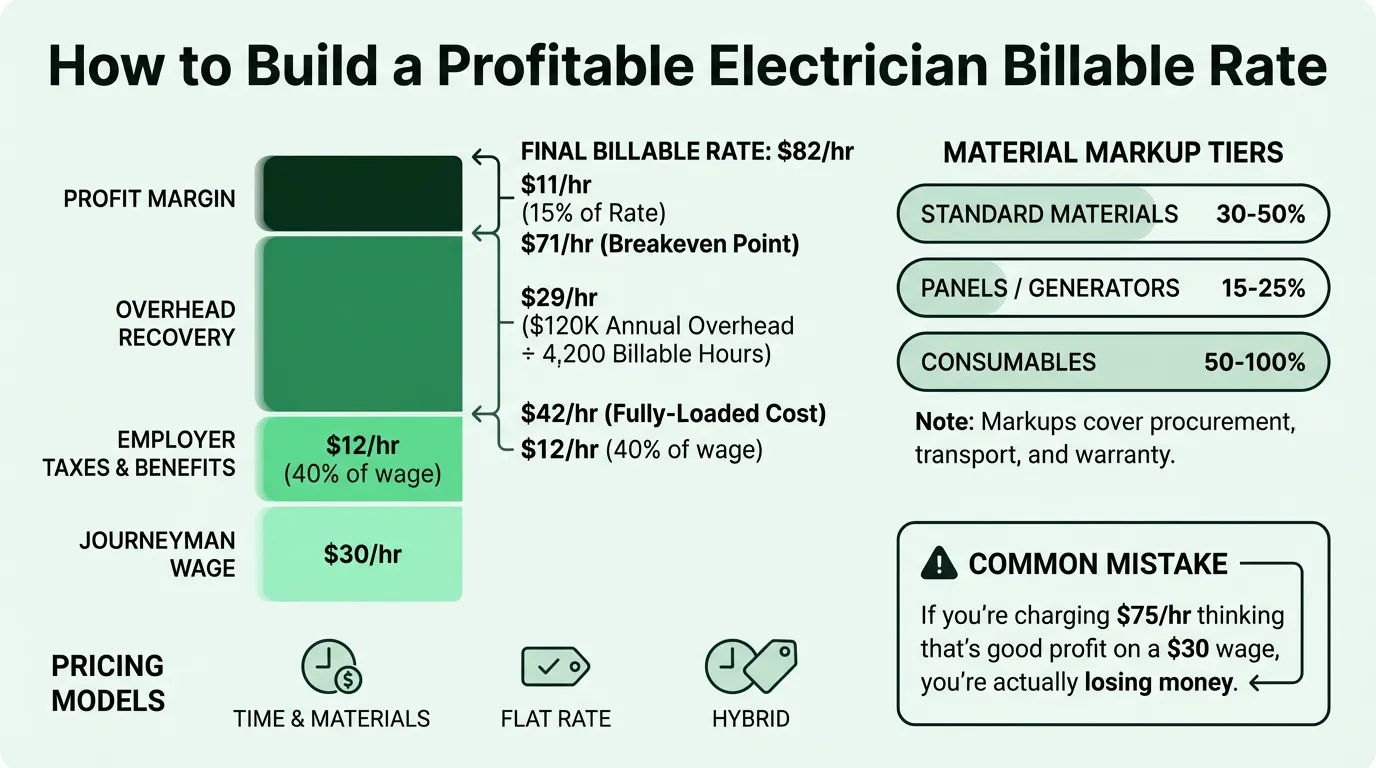
Here's the problem. A journeyman paid $30/hour in wages doesn't cost $30/hour to employ. Once you add employer payroll taxes (7.65%), workers' compensation insurance (trades run 10–20% of wages), health insurance, and paid time off, the true cost of that employee to the business is $40–$48/hour. You haven't charged a dollar yet.
Then there's overhead. Every hour of field work needs to carry a share of:
- Vehicle payments, fuel, insurance, and maintenance
- Liability insurance and contractor bonds
- Office rent, utilities, software, and phones
- Licensing fees, continuing education, and permits
- Marketing, estimating time, and administrative costs
According to industry benchmarks, overhead typically runs 13–20% of total sales for electrical contractors. That percentage has to be recovered through the labor rate.
Building a Billable Rate
The calculation works like this:
Step 1: Calculate annual overhead. Add up every business cost that isn't direct labor or direct materials — vehicles, insurance, office, tools, marketing, admin salaries. Say that totals $120,000/year.
Step 2: Calculate realistic annual billable hours. A technician has 2,080 hours available per year, but subtract vacation, holidays, and all non-billable time (travel between jobs, quoting, permit pulls, scheduling, callbacks). Most electricians actually bill 1,300–1,500 hours per year. With three technicians, that's roughly 4,200 billable hours.
Step 3: Overhead recovery rate. Divide annual overhead by total billable hours: $120,000 ÷ 4,200 = $28.57 overhead per billable hour. This amount must be in every hour you bill, before profit.
Step 4: Build the full rate.
| Component | Amount |
|---|---|
| Fully loaded field wage | $42/hr |
| Overhead recovery | $29/hr |
| Break-even cost | $71/hr |
| Profit (15%) | $11/hr |
| Billable rate | $82/hr |
If you've been charging $75/hr thinking that was plenty above your $30 wage, you've been losing money on every hour billed.
One more adjustment: most electricians bill based on 40 hours per week of work. But if your technicians are only billing 25–30 hours per week, you've already priced in a 25–37% shortfall before the first invoice goes out. Use real billable hours, not theoretical ones. The electrical break-even calculator lets you test how billable hour counts affect your required rate.
Material Markup
Materials should never be priced at cost. Buying, transporting, storing, and managing materials has real costs — plus the contractor takes on the risk of warranty, returns, and material price volatility.
Industry benchmarks for material markup:
| Material Category | Typical Markup |
|---|---|
| Standard wiring, conduit, boxes | 30–50% |
| Panels, generators, large equipment | 15–25% |
| Small consumables (connectors, tape, wire nuts) | 50–100% |
Two important distinctions here.
First, markup and margin are not the same thing. A 50% markup on a $100 item yields a $150 price — but that's a 33% gross margin, not 50%. If you're targeting a specific gross margin on materials, use the margin formula:
Selling Price = Cost ÷ (1 – Target Margin)
For a 40% gross margin: $100 ÷ (1 – 0.40) = $166.67. Using markup percentages to hit a margin target will consistently leave money on the table.
Second, copper prices fluctuate. Wire is often the largest single material cost on a job, and copper spot prices can swing 20–30% within a year. Build quotes from current supplier pricing, not from memory or invoices from six months ago. The electrical markup calculator converts between markup and margin so your material pricing stays accurate as costs change.
Flat-Rate Pricing: Building a Price Book
If you're doing mostly residential service work, a price book — a catalog of pre-calculated flat prices for standard tasks — is one of the best investments you can make in your business.
Each entry in a price book includes:
- Task name (e.g., "Install single outlet, new work, open wall")
- Material cost (current pricing)
- Labor time estimate with a buffer
- Overhead allocation
- Profit margin
- Final sell price
You calculate the price once, verify it periodically as costs change, and quote from the book rather than doing math on every call. This also makes it harder for customers to negotiate line by line — they're buying a completed task, not a time estimate.
The buffer in your time estimate matters. If you believe a task takes 45 minutes, price for 60. Unexpected complications — a stud in the wrong place, a breaker that won't seat correctly, an older panel that requires extra work — happen on a significant share of jobs. Building a 15–20% time contingency into flat rates is standard practice, not padding.

Need a ready-made budget template for your electrical?
Download a pre-built spreadsheet with industry-specific categories, formulas, and formatting.
Residential vs. Commercial Pricing
Commercial electrical work typically runs 20–40% more per hour than comparable residential work, and for concrete reasons:
Code requirements. Commercial jobs generally require EMT or rigid conduit where residential work allows flexible Romex. Conduit work is more labor-intensive and more material-intensive.
Insurance and bonding. Residential work requires about $1M in general liability coverage. Commercial work often requires $2–25M in limits, plus contractor bonds that can run $5,000–$100,000+ depending on the state. These premiums are real overhead costs.
Payment terms. Commercial clients typically pay net-30 to net-60. You're financing materials and labor for 1–2 months before you see a check. That has a real cost of capital, especially on larger jobs.
Documentation overhead. Commercial jobs require submittals, as-built drawings, inspection documentation, and change orders — none of which is billable field time but all of which takes hours.
Prevailing wage. Any public or government project may require prevailing wage rates, which can run 40–80% above standard market wages. If you bid a prevailing wage job at standard labor rates, you'll lose money before the first conduit is pulled.
If you're doing both residential and commercial work, price them separately. Running a blended rate across both will either price you out of residential work or underprice your commercial work — usually the latter.
Pricing Mistakes That Cost Real Money
Forgetting permit fees. Permit costs range from $75 on a simple residential job to $500+ on commercial work. These should appear explicitly in the quote, not absorbed into your margins.
Ignoring callback costs. Warranty callbacks — jobs you return to fix at no charge — consume billable hours that must be recovered elsewhere. If your callback rate is 5% of jobs, build that cost into your pricing model.
Scope creep on fixed-price work. The single most dangerous phrase in contractor work is "while you're already here." Additional work on a fixed-price job must have a written change order with an agreed price before you start. Without a change order, you're donating labor.
Not knowing your break-even. If you don't know your overhead and your actual billable hour count, you can't know whether a given rate covers your costs. Many contractors discover they've been losing money only when they run the numbers for the first time — often after several lean years. The Electrical Budget Template structures this calculation so you can see overhead per billable hour alongside your rate.
Tracking Whether Your Pricing Is Working
Pricing decisions need feedback. Track these metrics:
- Gross profit margin on completed jobs (revenue minus direct labor and materials, divided by revenue). Target: 65–67% for service work.
- Net profit margin after all overhead (target: 10–20%).
- Average job revenue vs. estimated time. If jobs consistently run over their estimated hours, your time estimates need adjustment.
- Material cost variance — what you estimated vs. what you actually spent. Significant variance either way indicates an estimating problem.
A simple spreadsheet is enough to track this across jobs. The Electrical Income Statement Template gives you a monthly view of labor margin, material margin, and overhead recovery built for how electrical contractors actually track finances. The construction budget template covers a similar structure for tracking estimated vs. actual costs by job — adaptable for electrical contractors who want to monitor job-level profitability alongside overhead.
What to Charge
The straightforward answer: charge what you actually cost to run your business, plus a profit that justifies being in business.
According to BLS data, the median U.S. electrician earns $62,350/year (about $30/hour in wages). Once overhead and profit are added, a properly priced billable rate for a journeyman electrician typically lands in the $75–$100/hour range depending on market. Master electricians and specialty work skew higher.
If your current rate is significantly below that range, run the overhead calculation from Step 3 above before your next estimate. The math usually tells you something useful.
And if you're not sure whether you're profitable at your current pricing, that's the first thing worth fixing — not the quality of your work, not your marketing, not your equipment. Profitable pricing is the foundation everything else depends on.
Last updated: March 25, 2026
Frequently Asked Questions
Related Articles
Auto Repair Pricing Guide: How to Price Your Shop Profitably
How auto repair shop owners should price labor and parts — covering labor rate calculation, flat-rate hours, parts markup matrices, diagnostic fees, and the metrics that matter.
Cleaning Service Pricing Guide: How to Price Your Business Profitably
A practical guide to cleaning service pricing — covering hourly vs. flat rate vs. per square foot models, price benchmarks by service type, labor cost math, and the common mistakes that keep cleaning businesses from hitting their margin targets.
Construction Pricing Guide: How to Price Your Work Profitably
How contractors should price construction work — covering labor burden, overhead recovery, material markup, pricing methods, and the mistakes that quietly erode margin.
Hotel Sales Forecast: A Practical Example and Guide
How to build a hotel sales forecast — covering rooms, F&B, events revenue, key metrics like RevPAR and ADR, booking pace, and the rolling forecast structure that keeps you ahead.
Landscaping Pricing Guide: How to Price Your Work Profitably
A practical guide to landscaping pricing — covering hourly rates, per-square-foot benchmarks, overhead recovery, and the markup math that determines whether you're making money.
Manufacturing Inventory Management: Best Practices
Practical manufacturing inventory management best practices — covering ABC analysis, MRP, WIP control, safety stock, and the metrics that matter most on the shop floor.