Construction Business Plan Template
A complete business plan template for construction contractors and construction companies. Model revenue from project pipeline and labor utilization, forecast startup equipment costs and funding needs, and project EBITDA across three years.
What's Inside This Construction Business Plan Template
This template includes 5 worksheets, each designed for a specific part of your construction financial workflow:
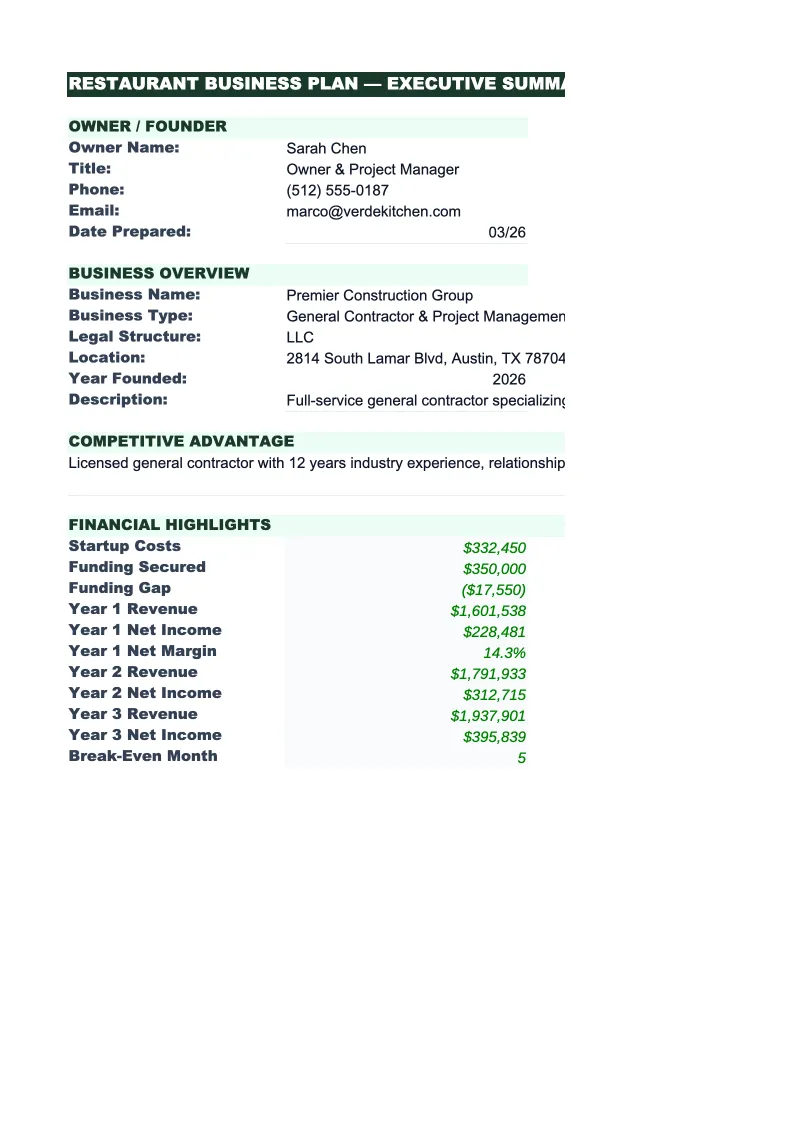
Executive Summary
The one-page overview of your construction business concept, ideal for bank lenders and equipment finance partners.
Startup Costs & Funding
Breaks down the initial investment required to start or scale a construction business: equipment purchase or lease (trucks, excavators, tools, machinery), office setup (computers, software, furniture), licenses and bonding (contractor licenses, business licenses, performance bonds), initial working capital for payroll and materials, insurance deposits, and initial marketing.
Revenue Forecast
A 12-month project-based revenue forecast built from your labor crew capacity and billable hours or project pipeline.
Projected P&L
Annual projections for years 1, 2, and 3 showing revenue, cost of labor (crew wages and burden), cost of materials and subcontractors, direct project costs, gross profit and margin, overhead (office, insurance, vehicles, equipment depreciation), and operating expenses (marketing, accounting, fuel, equipment maintenance).
Dashboard
A visual summary of your construction company's operational and financial health.
Construction Business Plan Template Features
- Project-based revenue model built from crew capacity, billable hours, and average project margin
- Service line breakdown (labor, materials, subcontracted work) with margin tracking by line
- Startup equipment and working capital budget with financing options (purchase vs. lease)
- 3-year P&L with labor cost, materials, subcontractors, and overhead separated for true gross margin visibility
- Labor utilization tracking—shows % of crew hours billable vs. overhead or idle
- Dashboard with cash conversion cycle, equipment ROI, project pipeline tracking, and operational metrics
How to Use This Construction Business Plan Spreadsheet
Start with the Executive Summary and Startup Costs & Funding sheets. Define your service lines (general contracting, specialty trades, heavy equipment rental) and calculate the equipment and working capital you need to launch. For a general contractor, estimate truck and tool costs; for heavy civil, factor in heavy equipment lease or purchase. Calculate how many crew members you'll employ and their payroll requirements for the first 12 months. This becomes your working capital need—most construction companies need three to four months of payroll plus materials float.
Next, go to the Revenue Forecast sheet. Enter your crew size, average billable hours per week (accounting for travel, bidding, and administrative time), and your target revenue per billable hour or average project size. The model automatically calculates monthly revenue and applies a ramp-up schedule for months 1–4 (new companies typically operate at 60–80% crew utilization while building the project pipeline). Adjust the ramp percentages and seasonal adjustments to match your market and service lines.
From crew and equipment plan to lender-ready business plan in under an hour
Enter your crew size, billable hours, project costs, and equipment needs. The template builds your 3-year financial projections, cash conversion cycle, and labor utilization analysis automatically.
Why Construction Companies Need a Solid Business Plan
A construction business plan serves two critical purposes: it shows a lender how you'll service debt with stable cash flow, and it forces you to think through the operational scaling required to hit your revenue targets. Equipment financing lenders want to see a detailed project pipeline and evidence that you have a backlog of work to service the equipment loan. SBA lenders focus on gross margin stability and your ability to manage labor costs and materials inflation. A plan that shows 50% gross margin but 45% labor burden will get rejected because there's no path to profitability.
The three metrics that define construction financial health are gross margin percentage (revenue minus direct labor and materials), labor utilization rate (% of crew hours that are billable vs. overhead), and cash conversion cycle (how many days from starting a project to collecting final payment). A construction company with 35% gross margin, 75% labor utilization, and a 30-day cash conversion cycle can hit 15% EBITDA at scale. A company where jobs run at 28% gross margin, crews are idle 30% of the time, and it takes 60 days to collect payment won't be profitable even if revenue is growing.
Construction Industry at a Glance
Financial templates built for construction companies — from general contractors to specialty trades. Pre-loaded with job costing categories, bid tracking, and project-based financials.
Revenue Drivers
- Project contracts
- Change orders
- Service & maintenance
- Material markups
Key Cost Categories
- Materials
- Labor (direct)
- Subcontractors
- Equipment rental
- Permits & insurance
- Overhead
Typical Margins
Gross: 20-35% · Net: 2-7%
Seasonality
Peak activity spring through fall; winter slowdown in northern climates. Year-end push to close projects.
Key Performance Indicators
Construction Business Plan Template FAQ
More Construction Templates
Construction Balance Sheet Template for Excel
$29
Construction Budget Template for Excel
$29
Construction Cash Flow Template for Excel
$29
Construction Expense Tracker Template for Excel
$29
Construction Financial Model Template for Excel
$29
Construction Income Statement Template for Excel
$29
Construction Invoice Template for Excel
$29
Construction KPI Dashboard Template for Excel
$29
Construction P&L Template for Excel
$29
Construction Pro Forma Template for Excel
$29
Construction Project Budget Template for Excel
$29
Construction Sales Forecast Template for Excel
$29
Construction Business Valuation Template for Excel
$29
More Business Plan Templates
Construction Business Plan Template
$39