Church Business Plan Template
Build a realistic church financial plan with member giving projections, operating expense budgets, and a 3-year outlook accounting for membership growth, seasonal giving patterns, and ministry fund allocation.
What's Inside This Church Financial Plan Template
This template includes 5 worksheets, each designed for a specific part of your church financial workflow:
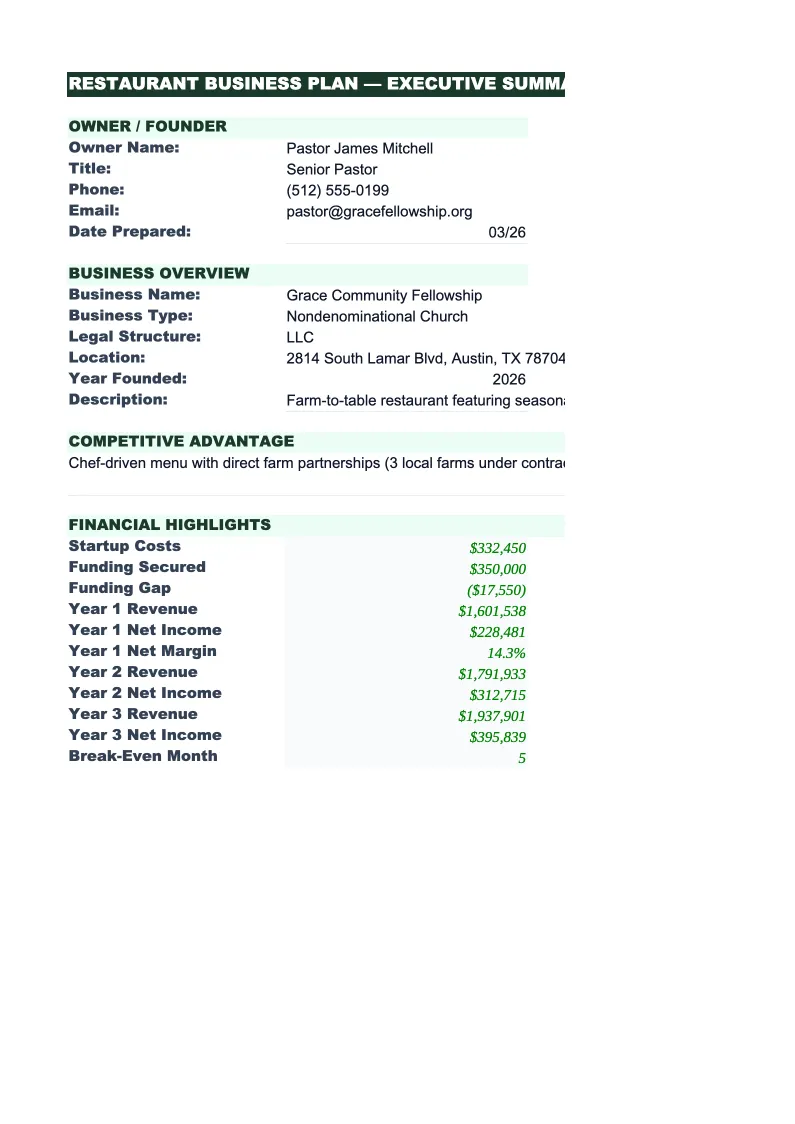
Executive Summary
A strategic overview of your church's financial plan, including mission, membership demographics, ministry focus areas, and financial vision.
Startup Costs & Funding
Details capital required to launch or renovate a church facility, typically $50,000–$500,000+ depending on scope.
Revenue Forecast
A 12-month detailed projection for year one, then annual summaries for years two and three.
Projected P&L
Annual operating budget showing total giving/contributions, cost of goods sold (if applicable—materials, supplies for outreach), ministry staffing (pastor, worship leader, children's director, administrative staff, typically 40–60% of operating budget), facility occupancy (building lease or mortgage, utilities, maintenance, insurance, typically 20–30% of budget), ministry expenses (supplies, materials, outreach, missions, typically 15–25% of budget), and administrative expenses (office supplies, software, professional services, typically 5–10%).
Dashboard
A visual management tool showing: total giving/revenue by month and year, active member count and growth trend, average giving per member, capital requirement and fundraising progress, operating budget allocation (ministry, facility, operations, missions), surplus/deficit by year, facility cost % of budget, ministry staffing cost % of budget, missions/outreach allocation %, and 36-month reserve balance (to ensure the church maintains a healthy emergency fund).
Church Financial Plan Template Features
- Member giving model with active member count and average annual gift assumptions
- Seasonal giving pattern adjustments (December giving peaks, summer dips)
- Budget allocation by function: ministry, facility, operations, missions, and reserve
- Staffing model for pastor, worship leader, and administrative roles
- Capital project tracking for facility improvements and equipment
- Financial health dashboard with reserve balance, deficit coverage, and giving trends
How to Use This Church Financial Plan Spreadsheet
Start with the Executive Summary to articulate your church's mission, vision, and financial goals for the next three years. Define your target membership size and ministry focus. Then use the Startup Costs sheet to budget for facility improvements, technology upgrades, and equipment. If you're renting space, budget for lease deposits and initial buildout; if you own or are purchasing a building, include down payment and renovation costs. A church plant starting in a rented space needs $20,000–$50,000; an established church renovating worship space might budget $50,000–$200,000+. Include working capital reserve (3–6 months of operating expenses) to ensure the church can weather seasonal giving dips without operational stress.
Move to the Revenue Forecast sheet and model your giving conservatively. Survey your current membership and estimate average annual giving per member: this varies widely depending on denomination, socioeconomic demographics, and theology (some traditions emphasize tithing, others emphasis according to ability and conviction). Ranges might be $500–$1,000 for younger or entry-level members, $1,500–$3,000 for mature giving members. Model membership growth realistically—a new church plant might grow 5–10% per year; an established church might grow 2–5% annually. Include seasonal variation: most churches experience 15–25% higher giving in December (year-end and holiday generosity), 10–15% higher in the months before Easter, and lower giving in summer months (vacation season, families out of town). Add non-member revenue: facility rentals, special offerings, grants. Calculate total giving and determine what's available for operations vs. reserved for building funds or missions.
From membership projections to leadership-ready budgets in an afternoon
Enter your member count, average giving, operating expenses, and facility plans—the model builds your 3-year financial outlook, seasonal cash flow, and reserve requirements automatically.
Why Churches Need Detailed Financial Planning
Church financial planning is fundamentally different from for-profit business planning because the goal is sustainability and ministry impact, not profit maximization. However, the same basic principles apply: you must know your revenue (giving), your expenses, and your reserves to plan effectively. Many churches operate with inadequate planning, leading to financial stress, delayed ministry expansion, or inability to weather unexpected expenses. A church with 100 active giving members at $1,500 average annual gift (reasonable for an evangelical church in a middle-income community) has $150,000/year to support ministry, facility, and missions. That's roughly $12,500/month—adequate for one pastor, basic administration, and facility costs, but tight for additional ministry staff or facility expansion. Understanding this constraint forces realistic planning: if you want to add a youth pastor ($40,000/year), you either need to grow membership by 25+ members (to generate additional giving) or redeploy resources from another area.
Seasonal giving patterns significantly affect cash flow planning. A church receiving 40% of annual giving in November–December must plan for low-giving months (June–August) when cash receipts might be 60–70% of the monthly average. Without adequate reserves, the church faces pressure to cut ministries or expenses during summer months when giving is weak. Most healthy churches maintain reserves of 3–6 months of operating expenses specifically to smooth these cash flow variations. If monthly operating expenses are $12,000, a church should target $36,000–$72,000 in liquid reserves. Many small churches operate with inadequate reserves (under $10,000), which creates constant financial pressure.
Church Industry at a Glance
Financial templates built for churches and religious organizations — facility rentals, ceremony fees, staff payroll, and ministry budgets.
Revenue Drivers
- Tithes and weekly offerings
- Facility rental income
- Special offerings (Christmas, Easter)
- School and childcare tuition
- Cemetery and memorial service fees
Key Cost Categories
- Personnel and housing allowance
- Facilities and occupancy
- Worship and ministry programs
- Missions and benevolence
- Administration and software
- Debt service
Typical Margins
Gross: N/A · Net: 0-5% operating surplus
Seasonality
Giving peaks at Christmas and Easter; summer typically sees 10-20% attendance and giving decline. Year-end giving surge in December is common for tax purposes.
Key Performance Indicators
Church Financial Plan Template FAQ
More Church Templates
Church Balance Sheet Template for Excel
$29
Church Budget Template for Excel
$29
Church Cash Flow Template for Excel
$29
Church Expense Tracker Template for Excel
$29
Church Financial Model Template for Excel
$29
Church Income Statement Template for Excel
$29
Church Invoice Template for Excel
$29
Church KPI Dashboard Template for Excel
$29
Church P&L Template for Excel
$29
Church Pro Forma Template for Excel
$29
Church Project Budget Template for Excel
$29
Church Revenue Forecast Template for Excel
$29
Church Valuation Template for Excel
$29
More Business Plan Templates
Church Business Plan Template
$39