Auto Repair Business Plan Template
Build a realistic auto repair business plan with labor billing model, technician capacity, and a 3-year financial projection accounting for parts markup, seasonal demand, and warranty work.
What's Inside This Auto Repair Business Plan Template
This template includes 5 worksheets, each designed for a specific part of your auto repair financial workflow:
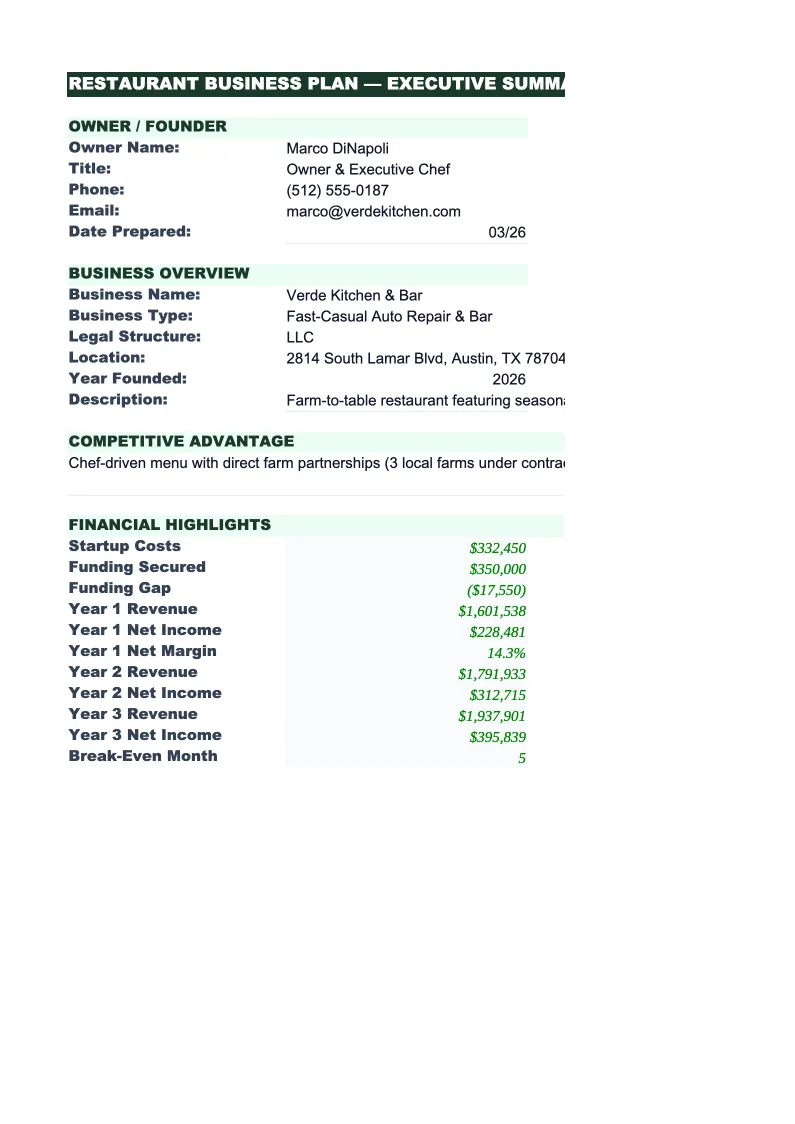
Executive Summary
A strategic overview of your auto repair shop, including service types (general maintenance, engine repair, transmission, electrical, brakes, fleet services), target customers (individual car owners, fleet accounts, dealership overflow), and competitive positioning (pricing, technology, specializations, customer service).
Startup Costs & Funding
Details capital required to open an auto repair shop, typically $80,000–$250,000 depending on scope.
Revenue Forecast
A 12-month detailed revenue projection for year one, then annual summaries for years two and three.
Projected P&L
Annual profit and loss statement showing labor billing revenue, parts revenue and markup, total gross revenue, cost of parts sold (the wholesale cost of parts you sell, typically 60–70% of parts revenue), technician wages (typically 40–55% of labor billing revenue), shop manager and administrative staff (typically 8–15% of revenue), occupancy (shop rent, utilities, equipment leases, typically 8–12% of revenue), and operating expenses (tool replacement, shop supplies, marketing, software, vehicle emissions testing, insurance).
Dashboard
A visual management tool showing: total startup investment and funding required, monthly and annual revenue by year, technician count and billable hours per day, billable hours utilization %, average revenue per technician per day, parts markup %,break-even billable hours per week (the weekly labor hours needed to cover all fixed and variable costs), labor cost % of labor revenue, parts COGS % of parts revenue, occupancy cost % of revenue, net profit margin %, and 36-month cumulative cash flow.
Auto Repair Business Plan Template Features
- Labor billing model with technician capacity and billable hours tracking
- Parts revenue modeling with wholesale cost and retail markup margin
- Service category breakdown (maintenance, diagnostics, major repair) with job pricing
- Technician utilization tracking (billable hours per technician per day)
- Startup costs for lifts, diagnostic equipment, tools, and working capital
- Break-even analysis showing required billable hours per week and technician utilization %
How to Use This Auto Repair Business Plan Spreadsheet
Start by defining your service scope and gathering equipment costs for the Startup Costs sheet. A small shop with one lift and basic tools can launch for $80,000–$150,000; a more comprehensive shop with multiple lifts, diagnostic equipment, and inventory needs $150,000–$250,000+. Major equipment costs: a 2-post lift ($3,000–$8,000), a 4-post lift ($5,000–$12,000), wheel alignment system ($8,000–$25,000), diagnostic scanner ($2,000–$10,000), air compressor, tool chest, and hand tools ($5,000–$15,000 total). Shop rent varies widely (urban $2,000–$4,000/month, suburban $800–$2,000/month). Include licensing (tech certifications), initial insurance ($3,000–$8,000 annually for liability and garage keepers), and 3–6 months of working capital ($10,000–$30,000) to cover the ramp-up period.
Move to the Revenue Forecast sheet and set your labor billing assumptions. Establish labor rates for your market and specialization: general technicians $80–$120 per billable hour, advanced diagnostics $100–$150 per hour. A technician working an 8-hour day typically has 6–7 billable hours (rest is training, tool maintenance, breaks). With one technician at 6.5 billable hours per day at $100/hour, that's $650/day in labor revenue. One technician can generate $130,000–$170,000 in annual labor revenue (depending on billable hours and rate). Add parts revenue: if parts represent 30–40% of total job cost on average, a shop generating $200,000 in labor revenue might generate $100,000–$120,000 in parts revenue (before markup). Model customer acquisition realistically: a new shop might start at 40–50% of one technician's capacity and ramp to 70%+ as word-of-mouth builds and customer base grows.
From shop concept to lender-ready projections in a few hours
Enter your labor rates, technician count, parts markup, and utilization assumptions—the model builds your 3-year financial outlook, break-even billable hours, and startup capital requirement automatically.
Why Auto Repair Shops Need a Detailed Business Plan
Auto repair economics are built on two revenue streams: labor billing and parts markup. Labor revenue is primary and predictable (you bill technician hours at a set rate); parts revenue is secondary and variable (depends on job mix and markup). A technician billing 6.5 hours per day at $100/hour generates $650/day in labor revenue; adding 30% parts markup on $650 in parts cost generates an additional $195, for total daily revenue of $845. The technician might cost $25–$35/hour in wages and benefits ($200–$280 per day), leaving $565–$645 daily gross profit before occupancy and overhead. The business model scales if you can keep technicians highly utilized (6.5+ billable hours per day is difficult to achieve consistently) and maintain healthy parts margins (30%+ is standard but competitive pressure often drives markup down to 20–25%).
The second critical metric is billable hours utilization—what percentage of technician time is charged to customers. A technician working 40 hours per week might bill only 24–28 hours (60–70% utilization) due to training, admin work, slow periods, and time between jobs. Shops struggle to exceed 75% utilization consistently. If utilization is below 60%, the shop is either under-booked (marketing problem) or inefficient (operational problem). Most shops target 65–75% utilization as realistic and achievable. The template models utilization explicitly so you can test: how many customers do you need to keep a technician at 70% billable? How does seasonal variation affect utilization? What happens if you add a second technician and utilization drops to 50% due to inefficiency?
Auto Repair Industry at a Glance
Financial templates built for auto repair shops — from single-bay independents to multi-location service centers. Pre-loaded with labor, parts, and overhead categories specific to the automotive service industry.
Revenue Drivers
- Labor (repair services)
- Parts sales
- Oil changes & maintenance
- Diagnostics & inspections
- Tire sales
- Shop supplies fees
Key Cost Categories
- Parts & materials (COGS)
- Technician labor
- Rent & occupancy
- Equipment & tools
- Utilities
- Insurance
- Marketing & advertising
- Shop supplies
Typical Margins
Gross: 50-60% · Net: 5-15%
Seasonality
Busiest in summer (June–August) and spring (March–May) for maintenance and travel prep; January–February are consistently the slowest months.
Key Performance Indicators
Auto Repair Business Plan Template FAQ
More Auto Repair Templates
Auto Repair Shop Balance Sheet Template for Excel
$29
Auto Repair Shop Budget Template for Excel
$29
Auto Repair Shop Cash Flow Template for Excel
$29
Auto Repair Expense Tracker Template for Excel
$29
Auto Repair Financial Model Template for Excel
$29
Auto Repair Income Statement Template for Excel
$29
Auto Repair Invoice Template for Excel
$29
Auto Repair KPI Dashboard Template for Excel
$29
Auto Repair P&L Template for Excel
$29
Auto Repair Shop Pro Forma Template for Excel
$29
Auto Repair Shop Project Budget Template for Excel
$29
Auto Repair Sales Forecast Template for Excel
$29
Auto Repair Shop Valuation Template for Excel
$29
More Business Plan Templates
Auto Repair Business Plan Template
$39